From the research (here and here) I did in film opening titles and sequences, I found that all films showed their production company and distributor at the beginning of their film. Most production company's feature the same logo/jingle/design at the start of every film they release instead of personalising them to a certain film. This is so audiences can easily recognise a production company because it uses the same logo.
Most companies use logos which define and show their title which sounds simple but it is very effective. An example is 'Dreamworks' who's sequence is a a boy sitting in the clouds which refers to dreams. Another is Lionsgate who sequence shows a gate being opened and Walt Disney Pictures shows the famous, iconic Disney castle which also reflects the fun, magical theme the films by Disney Pictures hold.
The most famous film logo would be Universal Pictures which shows the world where the text of the company appears over it. The world could resemble the 'universe'. All of these are recognisable as film institutions to release the film. Another is BBC Films which gentle shows the title over blue and gentle eases into the frame over black.
One that I used for research into our own production company was the logo for Working Title. The title 'working' means that something in the production and being created while 'title' refers to the name of the piece. Simply, Working Titles create productions with titles. Again these lights which form the shape for the logo are over black.
Alex and I decided we wanted our two minute opening sequence to feature a production company at the beginning so it looks like a professional film. Before we started our coursework, our classwork was subjected on Production companies, media institutions, mass media, brand ideology and so on. A task our class had to perform was to create our own company and include and ethos, ideology, etc...Alex and I used the production company our group had designed for our film 'Inspector'.
At first Alex and I tried to come up with our own title to fit the animations on screen. In the final video it is clear what animations we mean. We thought of the names 'Lens Flare' and 'Panormamic' as the animation/title shows a light beam flaring across the titles. We got this inspiration for our research into Universal, Lionsgate, Dreamworks, Walt Disney Pictures and other logos.
We on Panormaic Productions
On the iMac's, we were unable to create a title transition and include a picture but we found a transition/title we thought worked well as a production company. It features a flare of light as a title appears. We used this as it's quite, easy and the light could reflect making films like the sequences for most other film companies have.
On the iMac we were unable to change the font but the default, Times New Roman, worked well with our logo as it looks basic but the light flare adds a bit of fun.
Overall, this will only feature in the first 2 seconds of our beginning, but we wanted to make it look professional for our film.
Here is the final screenshot of our company's logo at the beginning of our film.
Showing posts with label Research. Show all posts
Tuesday, 10 January 2012
Saturday, 10 December 2011
Research - Titles
As the project requires the titles of the opening of a film, I looked at the different titles of films in general.
I looked at their names and their relevance to the film and how they are presented (font, style, etc..) and showed at the start (or end) of the film.
(1988. dir Tim Burton) The Beetlejuice titles are over back and have a logo styled title which refers to the plot of the film.
Ghouls, ghosts, etc..
Previous research on Beetlejuice
(1986 dir. John Hughes) The title for Ferris Bueller's Day Off is very simple, over black and in bright blue font. The font is styled in a outgoing way compared to a posh or very formal one.
Previous research
(1999 dir. David Fincher) Fight Club uses special effects in it's titles which follows the same formatting as the other titles (actors, director, etc...)
Previous research
(2010 dir. Neil Burger) The title for Limitless appears in a spiral while the rest of the visuals are moving to cause discomfort for the audience because of all the movement. This is because the plot of Limitless is similar to that of disorientation.
(2006 dir. Jonathan Dayton and Valerie Faris) The Little Miss Sunshine titles are simple. After a short cold opening which introduces the characters of the film, the title appears in a simple font over one of the character's faces.
Previous research
(1960. dir. Alfred Hitchcock)
The titles for Psycho are in black and white because the film is but there are some transitions over the title before it appears. This not only follows a design that the director, Alfred Hitchock, used in a lot of his films, but it connotes to the mystery/thriller genre because it causes the audience confusion.
Previous research
(1994 dir. Quentin Tarantino) The title for Pulp Fiction is very bold, bright and big which shows the title's importance to the film. The colour resemble that of 'orange pulp'. The font resembles the genre of the film which is a comedy, drama, thriller.
Previous research
(1987. Joel Coen)
The title for Raising Arizona is very clever because it is over black but silhouettes the background of a sunset which uses very warming, comforting colours.
Previous research
(1959 dir. Billy Wilder)
The Some Like It Hot titles are in black and white because the film is and they use a very fun font. This shows that the genre of the film is a comedy.
(1991 dir. James Cameron) The titles for Terminator 2 Judgement Day (ignore the title for Linda Hamilton) show the genre because the titles are printed on metal (the metal represents the terminators/robots). The fire below also symbolises that the film could foreshadow deaths and destruction which is in the sci-fi genre.
(2008 dir. Justin Chadwick)
The titles for The Other Boleyn Girl are very simple, over the visuals but with a few lens flares to focus on the title. The title itself uses a very simple font in capitals which shows it's importance.
Previous research
Over black, the titles for True Grit (2010 dir. Ethan and Joel Coen) are simple and yet show the genre. The font is similar to that commonly used a few years back and is similar to that of Westerns because the film is a western.
Previous research
(2006 dir. James McTeigue) The titles for V For Vendetta are over the visuals of the letter V in fire. This represents the film. After a cold opening which introduces Guy Fawkes, the film's title hints to more explosions and destruction. The red symbolises death and love and the capitals for 'VENDETTA' show it's importance.
Previous research
I looked at their names and their relevance to the film and how they are presented (font, style, etc..) and showed at the start (or end) of the film.
(1988. dir Tim Burton) The Beetlejuice titles are over back and have a logo styled title which refers to the plot of the film.
Ghouls, ghosts, etc..
Previous research on Beetlejuice
(1986 dir. John Hughes) The title for Ferris Bueller's Day Off is very simple, over black and in bright blue font. The font is styled in a outgoing way compared to a posh or very formal one.
Previous research
(1999 dir. David Fincher) Fight Club uses special effects in it's titles which follows the same formatting as the other titles (actors, director, etc...)
Previous research
(2010 dir. Neil Burger) The title for Limitless appears in a spiral while the rest of the visuals are moving to cause discomfort for the audience because of all the movement. This is because the plot of Limitless is similar to that of disorientation.
(2006 dir. Jonathan Dayton and Valerie Faris) The Little Miss Sunshine titles are simple. After a short cold opening which introduces the characters of the film, the title appears in a simple font over one of the character's faces.
Previous research
(1960. dir. Alfred Hitchcock)
The titles for Psycho are in black and white because the film is but there are some transitions over the title before it appears. This not only follows a design that the director, Alfred Hitchock, used in a lot of his films, but it connotes to the mystery/thriller genre because it causes the audience confusion.
Previous research
(1994 dir. Quentin Tarantino) The title for Pulp Fiction is very bold, bright and big which shows the title's importance to the film. The colour resemble that of 'orange pulp'. The font resembles the genre of the film which is a comedy, drama, thriller.
Previous research
(1987. Joel Coen)
The title for Raising Arizona is very clever because it is over black but silhouettes the background of a sunset which uses very warming, comforting colours.
Previous research
(1959 dir. Billy Wilder)
The Some Like It Hot titles are in black and white because the film is and they use a very fun font. This shows that the genre of the film is a comedy.
(1991 dir. James Cameron) The titles for Terminator 2 Judgement Day (ignore the title for Linda Hamilton) show the genre because the titles are printed on metal (the metal represents the terminators/robots). The fire below also symbolises that the film could foreshadow deaths and destruction which is in the sci-fi genre.
(2008 dir. Justin Chadwick)
The titles for The Other Boleyn Girl are very simple, over the visuals but with a few lens flares to focus on the title. The title itself uses a very simple font in capitals which shows it's importance.
Previous research
Over black, the titles for True Grit (2010 dir. Ethan and Joel Coen) are simple and yet show the genre. The font is similar to that commonly used a few years back and is similar to that of Westerns because the film is a western.
Previous research
(2006 dir. James McTeigue) The titles for V For Vendetta are over the visuals of the letter V in fire. This represents the film. After a cold opening which introduces Guy Fawkes, the film's title hints to more explosions and destruction. The red symbolises death and love and the capitals for 'VENDETTA' show it's importance.
Previous research
Narration
List of films I looked at with narration at the beginning.
True Grit - western
Fight Club - drama thriller
Kick-Ass - Action Adventure Comedy
Raising Arizona - comedy crime
Litmitless - mystery thriller
True Grit:
In 2010's True Grit (further analysis in to the titles here) the film begins with a narration by an older version of the young girl Mattie Ross. She explains how her father has been killed and how at the age of 14, she went out to try and find the man who killed her father. After the narration, the film follows the story of Mattie at the age of 14. Because the older Mattie narrates the story at the beginning it is obvious she survives the story to be able to tell it.
Fight Club:
The narration in Fight Club 1999 uses the flash forward technique. As the film begins, the narrator explains that he is the character who is seen tied to a chair with a gun in his mouth by another character. He explains other parts of how he got there but not enough for the audience to thoroughly understand - this is part of the Enigma Code which is used to entice the audience into wanting to know what happens in the rest of the film. The narrator mentions names and places and then the story goes back to another time where the narrator continues to narrate.
Later on in the film, this scene is revisited and the narrator comes back.
True Grit - western
Fight Club - drama thriller
Kick-Ass - Action Adventure Comedy
Raising Arizona - comedy crime
Litmitless - mystery thriller
True Grit:
In 2010's True Grit (further analysis in to the titles here) the film begins with a narration by an older version of the young girl Mattie Ross. She explains how her father has been killed and how at the age of 14, she went out to try and find the man who killed her father. After the narration, the film follows the story of Mattie at the age of 14. Because the older Mattie narrates the story at the beginning it is obvious she survives the story to be able to tell it.
START: 'People do not give it credence that a young girl could leave home and go off in the wintertime to avenge her father’s blood, but it did happen'
END: 'you must pay for everything in this world one way or another'
Fight Club:
The narration in Fight Club 1999 uses the flash forward technique. As the film begins, the narrator explains that he is the character who is seen tied to a chair with a gun in his mouth by another character. He explains other parts of how he got there but not enough for the audience to thoroughly understand - this is part of the Enigma Code which is used to entice the audience into wanting to know what happens in the rest of the film. The narrator mentions names and places and then the story goes back to another time where the narrator continues to narrate.
START: 'People always ask me if I know Tyler Durden' ....
Later on in the film, this scene is revisited and the narrator comes back.
Later on in the film when the scene is revisited in it's chronological form, the narrator says 'I think this is about where we came in'. This technique is a form of humour for the audience which helps them relate to the character but it also makes clear the structure that the scenes are in for the audience.
Kick-Ass:
Comedy Action Kick-Ass which is based on a comic book, uses a very basic yet effective opening sequence. The film begins with the institution names in the clouds above as the camera sways past them and then it establishes the setting of a city. As the camera continues to pan down, it stops behind a character on top of a building in a costume. This is when the 'narrator' begins to talk.
START: 'I always wondered why nobody did it before me...'
END: 'In fact, in the eighteen months since my mother died, the only epiphany I had was realising that, like it or not, life just goes on.'
The narrator explains how he became a superhero. The character the camera is focused on drops from the building to fly a cut to show the people on ground level watching in astonishment and the point of view shot of the character falling.
The character falls and crashes into a taxi. This is part of the comedy element Kick-Ass has. The narrator then explains that the character who was just seen is not the person talking 'That's not me by the way. That's some Armenian guy with a history of mental health problems'
The camera moves round the crushed taxi to show a number plate which is the title of the film. The narrator then explains that he is the titled character, 'Kick-Ass'
While the opening credits roll onto the screen (actors, writers, producers, soundtrack, costume, director, etc..) the narrator introduces himself as a teenage boy at school and explaining his life. This is a very simplistic but realistic opening title sequence. This way, the audience fully understand big events to the character's life before the movie and they have an idea into what their daily, normal life consists of. The audience also relate to the main character quickly and already side with him because they know more about him than any other character so far.
Raising Arizona:
Even though I have previously looked at the opening scene of Raising Arizona, here I am going to discuss the narration. The narration for Raising Arizona begins over black
START: 'Hi my name is H.I McDunnough'
END: 'and the answer to all our prayers'
This introduction narration is in the form of a cold opening. It roughly lasts 10 minutes long and it introduces the main character, how he came to meet his wife and how they are in the situation they are currently in. The narration is used for the audience to get a sense of the characteristics of McDunnough as he is a main character and to help move along the cold opening. Other than the narration, the cold opening follows the same procedure as any other type of opening scene of a film because it lasts 10 minutes.
The narration explains how McDunnough was a criminal who was always in jail, until he met Ed. He tells how he was often found back in prison and explains how he got out, married and found a place to live. It then goes on, with visuals and scenes to grasps an understanding, how they couple could not produce children.
McDunnough explains how a group of babies have been born and that their plan was to take one because they could not have children of their own and that the parents have too many children and it is only fair. After this, the title of the film silhouettes onto the screen with the sunrise through it and it shows the other titles too.
Limitless:
The subtitles are not featured on these screen shots for Limitless, but the film uses narration to introduce it.
The film begins with a man standing at the top of a very high building in a big City. There are people trying to reach him to hurt him and so he explains how his life hasn't been good lately and it's his fault. He looks as if he is about to jump off the building.
The film's title and opening credits appear after the camera falls down the building.
The narrator explains how his life before was ok and he explains how he got into his 'trouble'
The film then cuts back to before the scene just then. It's the same character but he looks very different. The narrator explains how that man is him and that he's not a 'tramp' and that he was a writer.
Wednesday, 7 December 2011
Chosen genre and audience
After looking at various genres of opening titles and sequences, Alex and I decided to focus on a crime/thriller genre. Because we are only creating a 2 minute film of an opening sequence and title, we did not have to create a full plot story so the first part of our film mainly covers the thriller genre, the crime aspect would be in the film later.
There are many types of hybrid thriller films. Here are some of the hybrids I found and a list of films that I have seen as examples:
Action adventure thriller - examples: North By Northwest, James Bond, Indiana Jones, the Bournes,
Crime thriller - Se7en, The Usual Suspects, Lock, Stock and Two Smoking Barrels
Sci Fi thriller - examples: Alien, Terminator 2 Judgement Day,
Western thriller - examples: 3:10 To Yuma,
Horror thriller - examples: Psycho (1960), The Sixth Sense, Jaws
Psychological thriller - Black Swan, Requiem For A Dream, Fight Club,
There are even such hybrids as 'Fantasy' thriller' such as the 1993 film Jurassic Park and even 'romantic' thrillers such as Mr and Mrs. Smith (2005), Charade (1963).
We researched into audiences and found that our audience would similar to that of the films I researched. Our audience would be both genres but mainly more focused on males instead of females (the females more than likely preferring rom coms and dramas to thriller and crime) but this does not say all females dislike the thriller genre. The age range our audience would be would be 15+ almost definitely, because most crimes involve weapons, blood and violence. There is no limit on the age range as thriller is a popular genre and many older people are interested in it, but for the case of our research into audiences, the age range would be 15-40 roughly.
For this specific part of researching for the course, I looked at these films for inspiration for our main task:
Memento
The Island
Inception
The Dark Knight
Limitless
Black Swan
As film's can be a hybrid of more than one genre, Alex and I liked the idea of our thriller tying in with elements of Film Noir thriller also including spy film elements.
Film Noir is a term used when describing many classic Hollywood crime dramas from the 30s, 40s and 50s. Of course, Film Noir's still exist today. The word Film Noir traditionally means 'Film Black' which refers to black and white so Alex and I are considering having a part of our film in black and white.
Film Noir's typically involve characters in suits, with briefcases and cigarettes. Top hats are too often used as well as guns and fast cars. Alex and I like the idea of our film being a 'thriller/film noir'
Here are a list of other thrillers which resemble that of the Film Noir genre.
James Bond
Shutter Island
Kiss Kiss Bang Bang
Pulp Fiction
Taxi Driver
The Godfather
Strangers On A Train
There are many types of hybrid thriller films. Here are some of the hybrids I found and a list of films that I have seen as examples:
Action adventure thriller - examples: North By Northwest, James Bond, Indiana Jones, the Bournes,
Crime thriller - Se7en, The Usual Suspects, Lock, Stock and Two Smoking Barrels
Sci Fi thriller - examples: Alien, Terminator 2 Judgement Day,
Western thriller - examples: 3:10 To Yuma,
Horror thriller - examples: Psycho (1960), The Sixth Sense, Jaws
Psychological thriller - Black Swan, Requiem For A Dream, Fight Club,
There are even such hybrids as 'Fantasy' thriller' such as the 1993 film Jurassic Park and even 'romantic' thrillers such as Mr and Mrs. Smith (2005), Charade (1963).
We researched into audiences and found that our audience would similar to that of the films I researched. Our audience would be both genres but mainly more focused on males instead of females (the females more than likely preferring rom coms and dramas to thriller and crime) but this does not say all females dislike the thriller genre. The age range our audience would be would be 15+ almost definitely, because most crimes involve weapons, blood and violence. There is no limit on the age range as thriller is a popular genre and many older people are interested in it, but for the case of our research into audiences, the age range would be 15-40 roughly.
For this specific part of researching for the course, I looked at these films for inspiration for our main task:
Memento
The Island
Inception
The Dark Knight
Limitless
Black Swan
As film's can be a hybrid of more than one genre, Alex and I liked the idea of our thriller tying in with elements of Film Noir thriller also including spy film elements.
Film Noir is a term used when describing many classic Hollywood crime dramas from the 30s, 40s and 50s. Of course, Film Noir's still exist today. The word Film Noir traditionally means 'Film Black' which refers to black and white so Alex and I are considering having a part of our film in black and white.
Film Noir's typically involve characters in suits, with briefcases and cigarettes. Top hats are too often used as well as guns and fast cars. Alex and I like the idea of our film being a 'thriller/film noir'
Here are a list of other thrillers which resemble that of the Film Noir genre.
James Bond
Shutter Island
Kiss Kiss Bang Bang
Pulp Fiction
Taxi Driver
The Godfather
Strangers On A Train
Research: Psycho
The 1960 cult classic Psycho (dir. Alfred Hitchcock) took audiences by surprise by being the most intense, scariest horror thriller with one of the most famous scenes in movie history. In the tense shower scene there is no skin or plunging of a knife shown on camera which makes Psycho so wonderfully scary.
There is the typical institution logo followed by a very artistic design transition which reflects Hitchock's style of films anyway. The title 'Alfred Hitchock's' shows how known his films are for the audience already. After another transition the title 'Pscyho' appears over black.
The title of the film is followed by cast members, the additional cast and then 'and Janet Leigh as Marion Crane'. By showing the actor and their character in a title shows their importance to the audience. After the assistant director, screenplay, editor and music..the last title ends with 'Directed by Alfred Hitchock'
There is then another transition which appears to be fun, but because of the heavily string focuses music in the background, the soundtrack gives out a feeling of tension and follows a theme of certain 'daggers' or strings. This reflects the theme of the film and causes the audience to feel intrigued to the film and also feel a little intense by it. The film begins with an establishing shot of a City to show the setting of the film. Titles appear over the City which explain the location in greater detail, the date and the time.
There is the typical institution logo followed by a very artistic design transition which reflects Hitchock's style of films anyway. The title 'Alfred Hitchock's' shows how known his films are for the audience already. After another transition the title 'Pscyho' appears over black.
The title of the film is followed by cast members, the additional cast and then 'and Janet Leigh as Marion Crane'. By showing the actor and their character in a title shows their importance to the audience. After the assistant director, screenplay, editor and music..the last title ends with 'Directed by Alfred Hitchock'
There is then another transition which appears to be fun, but because of the heavily string focuses music in the background, the soundtrack gives out a feeling of tension and follows a theme of certain 'daggers' or strings. This reflects the theme of the film and causes the audience to feel intrigued to the film and also feel a little intense by it. The film begins with an establishing shot of a City to show the setting of the film. Titles appear over the City which explain the location in greater detail, the date and the time.
The camera zooms to a window of a tall building and then through the window which makes the audience feel discomforted as they are invading someones privacy. This technique is very clever to make the audience feel discomfort.
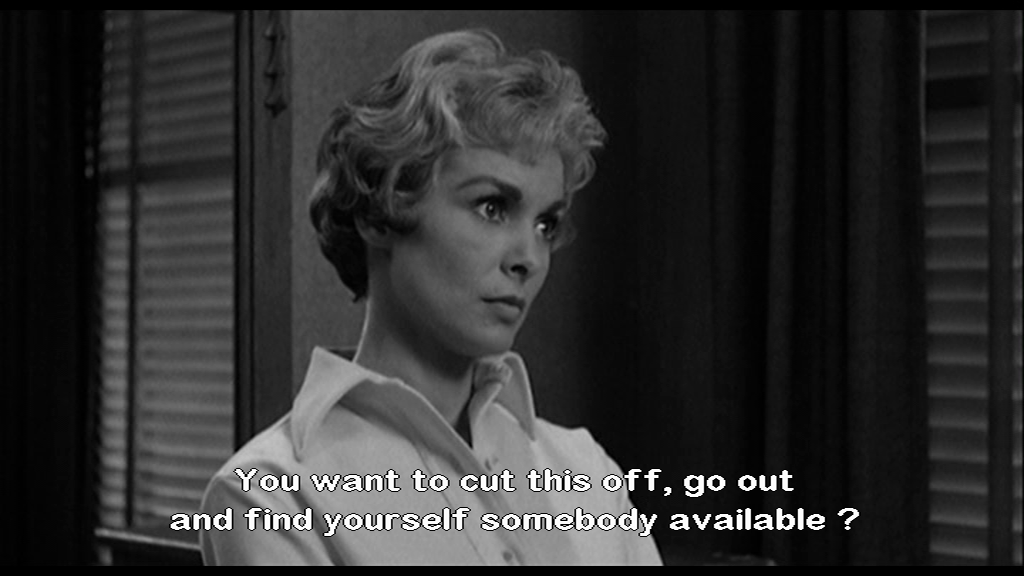
Inside the room there are two people together who talk about working and having to go abroad for work and the fact they are together. This appears normal but because of the conversation the audience feels even more discomfort but also curiosity to the couple.
Subscribe to:
Posts (Atom)