Monday, 14 November 2011

Research into the codes and conventions of Opening and Title sequences: Enigma Code

In this post I will be looking more at the Enigma Code of flashbacks and flash forwards, focusing on particular films opening titles and sequences as examples.
I looked at a few films which use this flash forward technique:
Fight Club, Limitless, Pulp Fiction, Inception.


Like I've previously mentioned in Fight Club (1999 dir. David Fincher), the opening scene is a flash forward as after this the film goes back for the central character (Edward Norton). Later on when the opening scene reoccurs in it's chronological form. When the opening scene is first looked at, Norton's character is narrating but his character says 'I can't think of anything'
When the scene is revisited, the narration says 'I think this is about where we came in'

Then 'I still can't think of anything'
which is in relation to the first line. The narrator is already directing their speech to the audience, but this technique of making apparent the change in narration and flashback/flash forwards entertains the audience.
Even Brad Pitt's character replies 'Ah. Flashback humour'

In this example of the flashback/flash forward technique, the filmmakers and script purposely mean for the narration to be noted by the audience as well as it being needed to help the story move along in a chronological form.


In the 2011 film Limitless (dir.Neil Burger), the opening scene starts with the main character (Bradley Cooper) standing at the top of a building narrating 'Obviously I miscalculated a few things' and moves his foot as if he is going to jump.
When the titles first appear, they appear after a 'bang' sound. Once the titles have finished, it's obvious the bang has been coming from the door being beaten.
Narration from the character begins; 'Obviously I miscalculated a few things'...the camera then scans the room while the narration continues. 'Why is is that the moment your life exceeds your wildest dreams..a knife appears.' The camera continues in a long shot around the hotel and the rooms.


'Well, I'll tell you one thing'..the camera then zooms upwards the tall building from the outside to find the central character.Because of this shot, the audience wonders why the character is standing at the very top because of it's height. '..I will never let them touch me'

'For a guy with a 4 digit IQ. I must have missed something. I cam this close to having an impact. And now the only thing I'd have an impact on, is the sidewalk'. Then the camera falls down the building and onto the sidewalk showing more titles for the film. The film then flashes back to what had occurred before the first scene.With an Establishing shot showing the town and then a zoom onto the character. The narration says 'That's me' with a bit more on an insight into what his life was like 'before'
Later on in the film the first scene is revisiting in chronological order. This time noting has changed since the first viewing except that the film continues so the audience cannot only find out what has happened before the ''Obviously I miscalculated a few things' and then also what happens after it.


In the film Inception (2010), director Christopher Nolan chose not not to have have his name or other credits at the beginning of the film- even the title of the film. This is quite rare.
After the institution logo, the film gets straight into a story which is a flashforward.
The opening scene shows Leonardo DiCaprio's character washed up on sand and taken to a room with an elderly man. DiCaprio's character does not exchange any dialogue instead, his facial expressions show confusion in response to the opposed character saying 'are you here to kill me' and that he has seen an object on the table 'many years ago'. This causes the audience to wonder what the object symbolises and why the other character would kill this man.
The film then cuts to another scene of DiCaprio and other new characters. There is no indication through cuts or titles to confirm that this scene occurs before the first scene. Instead the clothing and the situation for the main character has changed as well as the topic of conversation.
There is no thorough explanation of what the first scene means or explains but later (2 hours and 10 minutes later) on the scene is revisited for a shorter period of time.

 
In the 1994 film Pulp Fiction (dir. Quentin Tarantino), after the distributor's logo and this text:
(the definition of the word pulp referring to the title), the film opens to a scene involving two characters (Tim Roth and Amanda Plummer) at a table. They share lots of dialogue about money and robbing places.
With only a few cuts to the waitress and other characters, the 5 minute opening usually uses the 180 rule in the conversation between the two. Once they get up with their guns, the frame is frozen while the soundtrack begins to play, introducing the film's title and the other credits.

Throughout the rest of the film, the two characters in the opening scene are not seen again until this scene is revisited.
Later on, even though the opening scene is revisited in the chronological form, the camera shows the perspective of two other characters (John Travolta and Samuel L. Jackson) in the same location (the diner) as the two characters seen in the opening scene.

This technique is part of the Enigma Code in that the opening scene causes the audience to wonder what it's meaning and connection to the rest of the film is throughout the film. The flashback/flash forward in Pulp Fiction which shows another perspective is not commonly used as Tarantino has a unique writer/director trademark of non-linear storytelling.


All of these films share a similar trait; the opening scene is revisited later on in the film, usually in the chronological form. This revisiting usually happens after a series of events and the opening scene which is then revisited is either a big part/twist of the story or is simply makes everything that has previously happened add up.
This is a form of the Enigma Code which uses the flash forward/flashback technique.

Research into the codes and conventions of Opening and Title sequences

Opening scenes in films are a 'must have' when creating a film, because the first scene of a film is quite clearly the opening.
In researching into the codes and conventions of opening and title sequences of films, I nearly always found on media sties and in books from my school library, that the opening of a film aims to set the scene for the entire film and also makes clear the film's genre to the audience.
Further research and analysis into this idea of establishing the genre, I found that certain genres of films have obvious codes and conventions of their own to secure the genre for the audience. For example Action adventure films begin with an explosion or gun shot of some sort, signifying the action adventure genre and introducing the film. Another example would be a rom com film, which begins with an establishing shot of a the setting (usually a city or workplace) and then continuing with shots showing the daily routine of the central character, either male or female. This introduces the film and also will show the titles throughout.
Here is a rom com example in the film pretty woman.

After the institutions are shown the visuals stay black to show the films production company and then it fades from black to the film (hands of a group of people) as the rest of the films main titles (director) are shown.
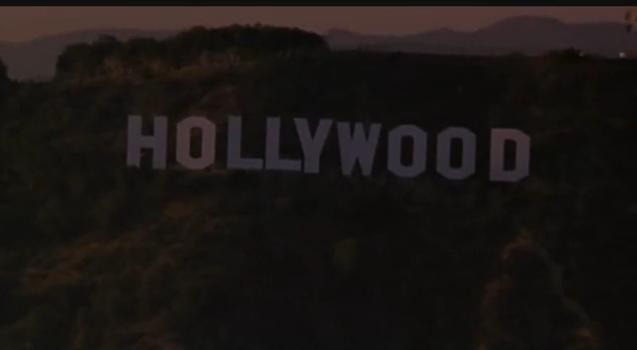
Then the camera continues show the daily routine of the main character. Then, as the camera continues to move around other characters, it shows the location the film is set. Hollywood.The film then introduces two of the main actors and then the title of the film.

One code in particular is used very often in films and that is the Enigma Code. In a simple definition, an Enigma Code is a way of pulling in the audience. It can not only be used in film openings but also in trailers as it sets a tone of mystery which is used to hook the audience into wanting to see it or in the case of film openings, make the audience continue to watch with an interest. This code is often used in film openings by using a flashback technique of having the first scene in the 'present' or for it to reoccur later on in the film. The 'flashback' or look on the plot from another perspective is used after the opening scene, giving the audience an insight into what has occurred before and therefore enticing them.

An example of the Enigma Code in an opening scene would be in David Fincher's 1999 cult classic Fight Club where it begins with Edward Norton's character tied up in a dark room with a gun pointed in his mouth, obviously after a rough beating and with his character narrating 'People always ask me if I know Tyler Durden'. The mise-en-scene of the room, clothing and bruises and cuts over the character entice in the audience into wanting to know what has happened to the character for him to be in this state. The narration also hooks the audience, introducing a character's name 'Tyler Durden' causes a mystery to the audience and some interest into his involvement into the characters current situation.


A simpler example of this from my own mind would be a film opening with a town or city in total destruction without a population, so lots of abandon shops and vehicles but then, a single person would be revealed, being healthy and alive. This form of the Enigma Code would cause the audience to have an interest into what has happened to the setting and where the normal everyday life involving people has gone to and why.


In the Enigma Code I briefly mentioned the 'flashback'. Most flashbacks occur after the first scene of the film, so technically speaking the first scene is the flash forward. This is another commonly used convention in opening scenes. By opening with the first scene which chronologically is a 'flashfoward', this confuses the audience by not letting them know the whole plot.
This convention usually occurs in two different ways. An opening scene which involves a narration over the film by a main character who explains what has happened before this current scene or introduces them- both connect with the audience as they are directly speaking to them which involves them into the film and character's situation. The other way the flashback opening scene convention is used, frequently involves a usual opening scene involving dialogue between two or more characters in a situation which will later on coincide with the overall plot. After both of these opening sequences, the films move on to the plot which has occurred before the first one. Later on the first scene is revisited, sometimes in a different manner of angles or the dialogue is slightly changed to give a different perspective now the plot has been explained and in some instances the film points out that is is a flash back to create humour and connect with the audience (eg. Fight Club). Though, in most instances of the flash forward/flashback technique, the first scene is revisited without any change from the first viewing.

Friday, 4 November 2011

Research

Here is a list of film openings I am going to watch to studying very closely, analyse and hopefully gain inspiration from for my final film title opening sequence.

Fight Club (1999)
Ferris Bueller's Day Off (1985)
Some Like It Hot (1959)
Terminator 2: Judgement Day (1991)
True Grit (2010)
Beetlejuice (1988)
The Other Boleyn Girl (2008)
Psycho(1960)
Pulp Fiction (1994)
Little Miss Sunshine (2006)
The Dark Knight (2008)

I have chosen these films because they are all quite different genres from one another so I can investigate into different genre codes and conventions in opening titles. These films I have selected are from a range of different years so I can also investigate if film opening titles have changed over the years and if they have- how?
In these analyses I will be looking at the camera angles and shots, the use of sound, the mise-en-scene and the editing of the titles.
Though my final production must last a maximum of 2 minutes, most of the film titles I am going to be looking at will last longer than this because most are big budget films, have long durations of films all together and a longer production schedule than A Level coursework.

Preliminary task

On Monday 17th October, Alex and I spent 30 minutes of class time importing our footage onto the mac to edit.
Then today (post first made on 18th October 2011) during our 2 media lessons between 9-11, we editited out prelim task.
This took a lot less time than we thought due to us planning in advance, making sure we had all the correct footage and an audio traack to use in the background


Here is my storyboard for the Preliminary exercise.


Here is the final cut of our Prelim exercise.